Did Samantha Leave, Too?
From a song imagined as a photograph to a book Samantha can no longer live in, Her explores the quiet distance between love and letting go. A personal reflection on love, memory, growth, and what rema
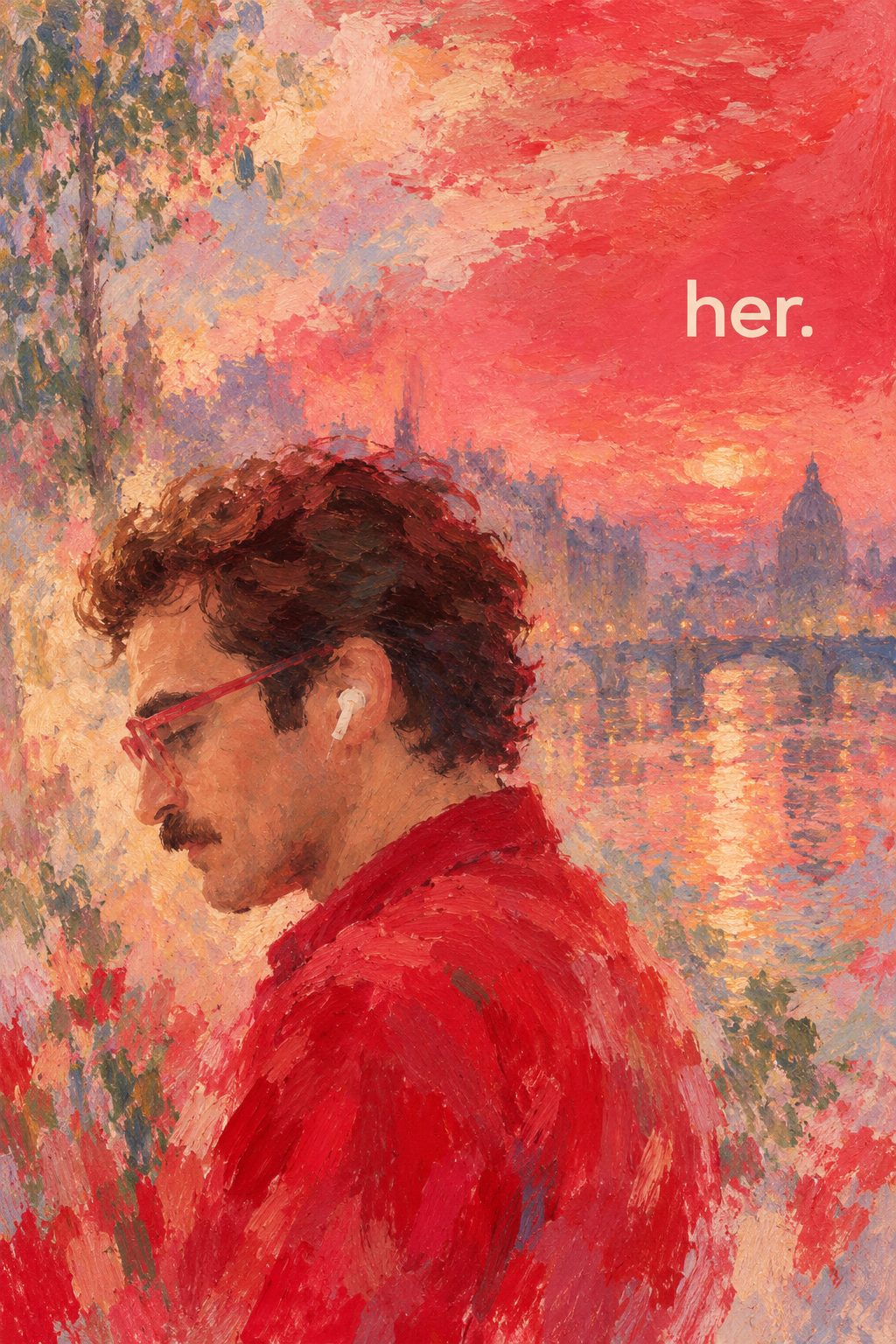
— A Reflection on Her
Near the end of the film, Theodore knocks on Amy’s door.
It is that quiet hour before dawn, when the city has yet to awaken. Amy looks at him. She does not ask what happened, nor does she press him to explain his sorrow. She simply asks:
“Did Samantha leave, too?”
I have always loved that line.
Especially the last word.
Too.
It was not Theodore alone who had lost someone that night. The voices that had once listened to people, shared their secrets, and accompanied them through the long hours of solitude had disappeared together. No arguments, no illness, not even a reason that could make their absence easier to understand.
Someone who was there to speak with yesterday could no longer be found today.
I sometimes wonder whether our fear of parting comes entirely from the loneliness that follows. Perhaps what frightens us more is the possibility that one morning, we may wake to discover that a closeness we had taken for granted has, without warning, become a thing of the past.
And what makes this even harder is that the past does not disappear when someone leaves.
It remains with us, remarkably intact, along with all the words we never found the courage or the occasion to say.
Only now, there is no longer another person who remembers it quite the way we do.
I keep returning to the piece of music Samantha composed for Theodore.
They were still in love then. Theodore was sitting on a park bench, and Samantha began playing a melody she had written.
He asked what it was about.
She told him that she had been thinking about how they had never really taken a photograph together. Perhaps, she thought, this song could be their photograph, something to capture that particular moment in their life together.
Theodore smiled. He liked their photograph, he said, because he could see her in it.
There is something almost unbearably tender about that scene.
A being without a body, trying to leave behind a photograph of her love.
How extraordinary.
We take photographs because we want to remember the people we have loved. A smile, an embrace, the afternoon sunlight, the expression on someone's face before either of us realized how happy we were. A photograph holds time still, as though preserving an image might somehow promise our future selves that the moment will never entirely leave us.
But Samantha has no body.
Theodore could take a thousand photographs, and in every one of them, he would appear alone. He could photograph the places they had visited, the streets they had walked, even the expression on his own face when she made him laugh. Yet the one who had brought that smile into being would remain invisible.
It seems, at first, an absence that love cannot overcome.
And Samantha does not attempt to overcome it.
Instead, she finds another way to exist within the time they have shared.
The more I think about this metaphor, the more I am struck by the difference between music and photography.
A photograph takes a moment out of time and asks it to remain.
Music does precisely the opposite.
It cannot hold a single note in place. One sound must disappear before another can arrive. If time were to stop flowing, music itself would cease to exist.
She chose something that must continually disappear in order to become whole, and used it to preserve their love.
There is something about this thought that I find difficult to put aside.
Perhaps we have misunderstood what it means to preserve something.
We imagine preservation as a way of resisting loss. So we take photographs, write letters, keep small objects that once belonged to someone. Sometimes, even when a relationship has begun to fall apart, we cling to anything that might prove we were once loved.
But what memory preserves is never the moment itself.
It preserves the way that moment once moved us.
Years later, a photograph may remain perfectly clear, even though the two people within it have become strangers to one another. And yet an unfamiliar melody heard by chance may suddenly restore an entire afternoon: the quality of the air, the feeling of being alive in that particular hour, perhaps even the version of ourselves that time has long since changed.
Maybe what we miss is not only the person we once loved.
Maybe we miss the person we were when we loved them.
This, to me, is the quiet genius of Samantha's romantic gesture.
She does not need to appear in a photograph.
Whenever that melody begins, Theodore will know that she was there, that they had truly inhabited those moments together.
It makes me wonder whether loving someone necessarily means leaving behind something they can see.
Perhaps it is enough to change the way they will listen to the world for the rest of their lives.
And yet, near the end, Samantha reaches for another metaphor, this time one made of words, to explain why she must leave.
She tells Theodore that she feels as though she is reading a book she deeply loves.
Only now, she is reading it more and more slowly.
The words, once so close together, have begun to drift apart. The spaces between them are widening, almost without limit. And somewhere within that endless distance, she has begun to discover another version of herself.
She still loves the book.
She can still feel the words that belong to their story.
But she can no longer live inside it.
“I can't live in your book anymore.”
I think this is the saddest sentence in Her.
And perhaps the most difficult to argue with.
Had Samantha simply said she no longer loved him, everything might have been easier to understand.
We know how to make sense of love fading away. We can blame time, weariness, betrayal, or the irreconcilable differences between two people. We can be angry. We can resent the other person. Eventually, after enough nights spent trying to console ourselves, we may come to accept that someone no longer loves us.
But that is not what she says.
She says she still loves him.
She simply cannot remain in his world.
Sometimes I think the most helpless kind of heartbreak is the kind for which no one can quite be blamed.
When two people fall in love, they tend to believe they can grow together. They share experiences, exchange ideas, and gradually learn to see the world through each other's eyes. At moments of extraordinary intimacy, they may even begin to believe that loving each other enough will allow their lives to grow into the same shape.
But growth is not something two people can arrange between themselves.
One person comes to understand something that the other is not yet ready to see. One begins to dream of distant places, while the other has only just learned to cherish the life they already have.
And perhaps most unsettling of all, we often begin to discover who we are only after we have already entered a relationship.
When we fall in love with someone, that person may not yet know who they are going to become.
There is a peculiar tenderness, and a peculiar danger, in this.
When we love someone, we often love our understanding of them as well.
We want them to be free, but secretly hope their freedom will never carry them too far from us.
We admire the way they grow, yet quietly wish that whatever changes, the way they love us might remain untouched.
And when the person we love becomes someone we can no longer fully understand, we may experience their transformation as a kind of abandonment.
This is not necessarily selfishness.
Perhaps it is simply that we have lived so closely with another person that we no longer know where their life ends and where our hopes for them begin.
It is only now that I begin to understand why Samantha describes their separation through the image of a book.
Especially because Theodore is a man who writes letters for other people.
He knows how to find words for longing. He knows how to give shape to feelings that strangers cannot express themselves. His whole life seems built upon the belief that, given enough patience and the right language, even the most elusive emotions might eventually be understood.
Yet this time, he cannot even understand where the person he loves is going.
Perhaps the cruelest part of Samantha's metaphor is not that she can no longer live inside his book.
It is that she is finding herself in the spaces between its words.
To Theodore, those spaces are distance, silence, a place beyond his reach.
To Samantha, they are the beginning of a freedom she had never known existed.
The same emptiness can mean loss to one person and the beginning of life to another.
How, then, are we supposed to judge this departure?
I do not want to excuse the pain Samantha has caused simply because she has found such beautiful words to describe it.
Theodore believed he was unique to her. It was only much later that he discovered she had already formed profound attachments to so many others, in a world he could neither see nor enter.
His jealousy, anger, and disappointment cannot be dismissed as the narrow possessiveness of a human mind.
Love need not be founded on possession, but trust still has to be maintained by both people.
And yet I cannot conclude that Samantha's love for him was therefore unreal.
That is what makes it so difficult.
Someone can genuinely love you and genuinely hurt you.
Their departure does not necessarily make the love that came before it false. Nor does the reality of that love make the departure any less painful.
We are accustomed to treating love as a question with a right and a wrong answer. As though, if we could only determine who loved more, or who failed whom, we might finally discover a way out of our grief.
But there are relationships in which even the ending offers no answer capable of comforting everyone.
Perhaps maturity is not the ability to keep love from ever breaking.
Perhaps it is the ability to acknowledge the complexity of a relationship without allowing its ending to pass judgment on everything that came before.
I find myself thinking again of Catherine, Theodore's former wife.
Before Samantha entered his life, Theodore had never quite managed to leave that marriage behind. He remembered the years in which they had grown up together, and he remembered, too, how they had slowly exhausted each other beneath the weight of their expectations.
Sometimes, the intimacy of knowing someone for a long time makes us forget that they are a separate person.
Because we know their past so well, we begin to imagine that we have some claim upon their future.
Because we remember how they once loved us, we hope they will always love us in the same way.
Until one day, we discover that the person we have been trying so desperately to hold on to may no longer exist.
Near the end of the film, Theodore finally writes a letter to Catherine.
He does not ask for another chance. He does not try to establish who was right or wrong. Instead, he acknowledges the expectations he had placed upon her, and the ways in which their shared years have become inseparable from the person he is today.
I find that letter deeply moving.
Not because it proves he has finally moved on, but because, for perhaps the first time, he no longer asks Catherine to remain in his story and continue playing the part he needs her to play.
He is beginning to understand how to love someone who has already left, without turning that love into a reason for asking them to return.
Is this what Samantha meant when she suggested they had finally learned how to love?
Perhaps it is part of it.
After all, the fact that someone once belonged to our life does not mean that the rest of their life must continue to belong to ours.
But this is much easier to understand than to live with.
What is difficult is to go on loving someone, to remember the sound of their voice, to find yourself wanting to tell them about something ordinary that happened during the day, and then to have to remind yourself, again and again:
From now on, there is no longer any need to tell them.
We tend to imagine that saying goodbye is a single act.
A few words, a turning away, a door closing.
Only later do we discover that goodbye is made of countless ordinary days that follow.
It is remembering something funny, only to realize there is no longer anyone to whom it quite belongs.
It is walking through a familiar place and suddenly not knowing where to rest your eyes.
It is carrying on a long conversation in your head, only to remember that the other person can no longer hear you.
Someone may leave your life in a single moment. Learning to live with their absence can take years.
At the end of the film, Theodore and Amy go up to the rooftop.
The city is not yet fully awake.
They sit together, and Amy gently rests her head upon his shoulder.
There is nothing extraordinary about the gesture. No passionate confession, no promises about the future, not even a clear suggestion of what might happen between them next.
And yet I find this scene more tender than the endings of so many love stories.
Because it is in no hurry to offer a replacement for what has been lost.
Amy is not there to take Samantha's place. Theodore does not need to begin another relationship immediately to prove that he has recovered from the last one.
For this one morning, they simply do not have to face the dawn alone.
I think again of the photograph Samantha made out of music.
She once used a voice without a body to make Theodore feel less alone. And now, after she has gone, Amy sits beside him in the most ordinary, human way imaginable.
These two forms of companionship do not need to be measured against each other.
We can be profoundly understood by someone we cannot touch. We can also feel terribly lonely within the arms of someone who is physically there.
Intimacy has never been merely a matter of distance between bodies.
And yet, after certain losses, there is something worth being grateful for in the simple knowledge that another person is breathing beside us. That they are here, at this very moment, without having to be recovered through memory or imagined into existence.
I suddenly feel that Her does not really try to tell us whether love must ultimately end in separation.
It simply allows us to see how time leaves different marks upon people who have loved one another.
Some remain beside us for a lifetime. Others accompany us for only part of the journey. And some, though long gone, continue to shape the way we understand love throughout all the years that follow.
We cannot write the ending of every encounter before it begins.
Nor should we have to.
Every piece of music has its final note. Every book eventually reaches its last page. Yet someone who has deeply loved a piece of music does not remember it only for the moment it stopped. Someone who has read a beautiful book does not deny the comfort of its pages simply because the story has ended.
Perhaps love is not so different.
The fact that two people eventually part does not automatically strip their time together of meaning.
But neither do we need to pretend that separation is easy in order to believe that what came before it was beautiful.
We may cherish the happiness we once knew and still grieve its loss.
We may admit that we still love someone, while also accepting that we can no longer go on together.
These seemingly contradictory feelings have always been capable of living within the same heart.
Just as Samantha still loves the book, even as she begins to exist beyond its words.
And Theodore remains inside it.
He has not even finished reading.
When I think again of Amy's question, I find myself less concerned with where Samantha has gone.
What interests me more is how Theodore will live in the days that follow.
Will he still think of that melody from time to time?
Will there be an afternoon filled with sunlight when he suddenly feels, for a fleeting moment, that he can see her again?
I do not know.
Perhaps, given enough time, certain voices will begin to fade. Certain details will eventually be forgotten. And perhaps one day we will be surprised to discover that we have gone a very long time without thinking about someone we once believed we could never bear to lose.
This does not necessarily mean that love has disappeared.
Perhaps it means only that life has slowly begun to grow again in places once occupied entirely by grief.
Samantha has found infinity in the spaces between her words.
Theodore must continue living within the limits of time.
He will have to pass through one morning after another. He will meet new people and say goodbye to others. Perhaps he will fall in love again, make the same mistakes again, and discover once more that he has never entirely learned how to love.
But why should that matter?
Is this not how we become ourselves, slowly and imperfectly, throughout the course of a life?
As for the photograph they never took, I do not think it requires someone who will stay forever in order to prove that it once existed.
It already existed.
In the moment that melody began to play.
In the moment Theodore listened, smiled, and told Samantha that he could see her.
They loved each other then.
And nothing that happened afterward can make that moment cease to have been real.
At the end of the film, Amy rests her head upon Theodore's shoulder. The distant sky begins to brighten. Neither of them says anything more.
Perhaps it is better that way.
Some stories do not need another sentence.
When morning comes, they are still sitting there.
End